
This piece was written in 2025 for Shawn Seguin, and was premiered at the International Double Reed Society conference at Butler University on July 11, 2025. This piece is a four-movement, programmatic work about the development of AI and its interactions with humans. The score can be obtained by contacting the composer directly.
It is worth noting that the piece was written for the Line6 DL4 MkII pedal, with detailed settings for all of its models. The looper also needs to have three tracks. The original pedals used for this piece are:
The first movement, "Dawn," is minimal in its use of electronics. The pitch shifter is set down a perfect fourth. The sample and hold pedal is used most frequently to create drone textures. The delay pedal is set to the "octo reverb," which adds extra octaves into the reverberated sound.
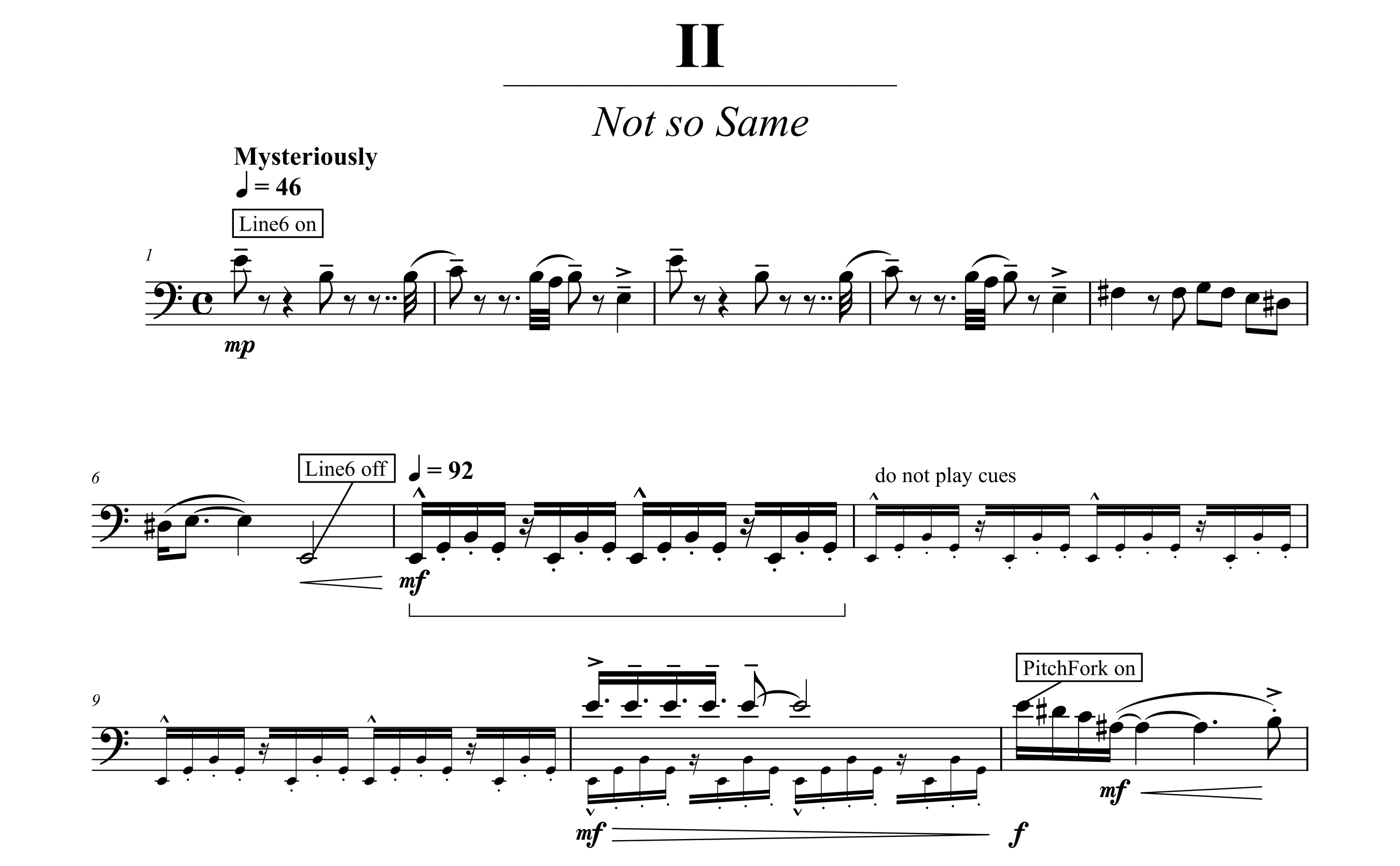
The second movement, "Not So Same," uses the pitch shifter set to up an octave. The delay pedal is set to the "multipass delay," that features filter sweeps in the delays. A single loop is also used. This movement is perhaps the most friendly to substituting in other pedals.
The third movement, "Yet, Not So Different," sets the pitch shifter to down an octave, but changes to up an octave in the middle of the piece. Three independent loops are used in this movement.
The fourth and final movement, "An Aid Now a Crutch," sets the pitch shifter down an octave, but changes to an octave up as well as a minor second up and back to down an octave throughout the movement. The delay pedal is set to "glitch," which uses granular synthesis to create lots of short delayed sounds. Again, three independent loop tracks are required.
Overall, this piece targets specific pedal models and it is hard to substitute some of them with generic pedals, but the textures they create are impressive. A possible setup diagram is shown below.

The technical demands of this piece are not too great; the third movement is a bit high and the fourth a bit fast. Other than that it should be manageable by undergraduate students. The electronic difficulty is more advanced, requiring quick pedal changes as well as controlling three loops at once. This probably would not be a good first electronic piece, but could be done after a bit of familiarity with the pedals involved. Perhaps the greatest hindrance is the targetted nature of the pedals, but each pedal should serve electric performers well for many pieces.
The style of this piece is very accessible, and should be enjoyed by most audiences.
©2026 by Benjamin Bradshaw
Logo ©2026 by Hannah Bradshaw